Author: Lainey

  • 5 AM Alarms & 15 Rescues: My Survival Guide to Life as a Tired Pet Mama

    5 AM Alarms & 15 Rescues: My Survival Guide to Life as a Tired Pet Mama

    (This article contains affiliate links, which means I may earn a commission at no extra cost to you.
    I only share products I genuinely use and believe in!!)

    People always ask me what it’s like to live with 13 cats and 2 dogs. Well… it’s a lot. Imagine a high-stakes, high-volume reality show where the stars have paws, the dialogue is mostly meowing, and I’m the director, chef, and head of security all at once. People always assume I’m one of those “naturally high-energy” types who loves a 5 AM sunrise

    The truth? I’m naturally a total zombie. I’m a ‘stay-in-bed-until-noon’ person living a ‘5-AM-alarm’ life. But Because I have 15 animals who depend on me, I’ve had to use science to ‘hack’ my energy just to keep up.”

    So here’s a sneak peek into what an average day looks like and how I manage to survive 

    5:00 AM The Pet Pile 
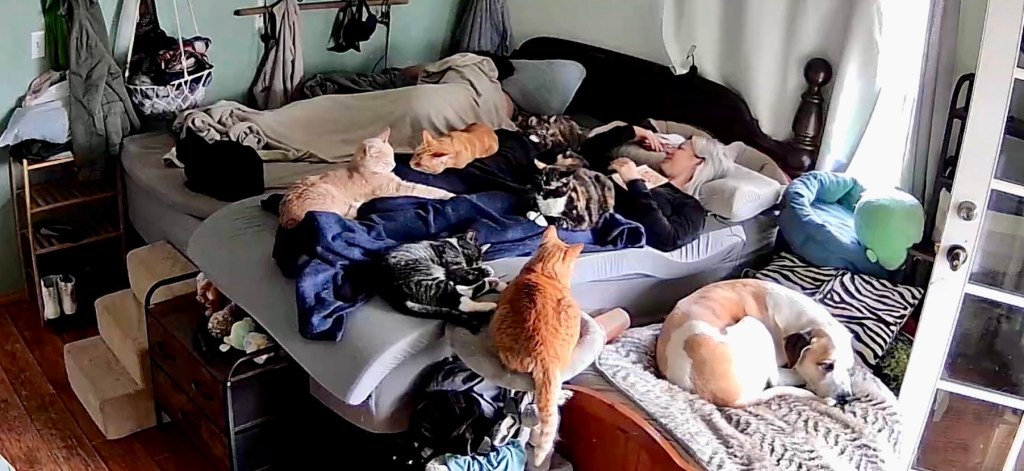
    A cozy bedroom scene featuring a person lying on a bed surrounded by several cats of different breeds and colors, with a dog resting nearby and various blankets scattered around.

    The alarm hasn’t even finished its first beep before I’m covered. It’s a 15-animal pileup: cats purring on my chest, dogs nudging my elbows, and “Cat Dad” somewhere in the middle of it all. Those first few minutes of snuggling are the best part of my day, but they are also the calm before the storm. Because once I hit the floor, the clock is ticking.
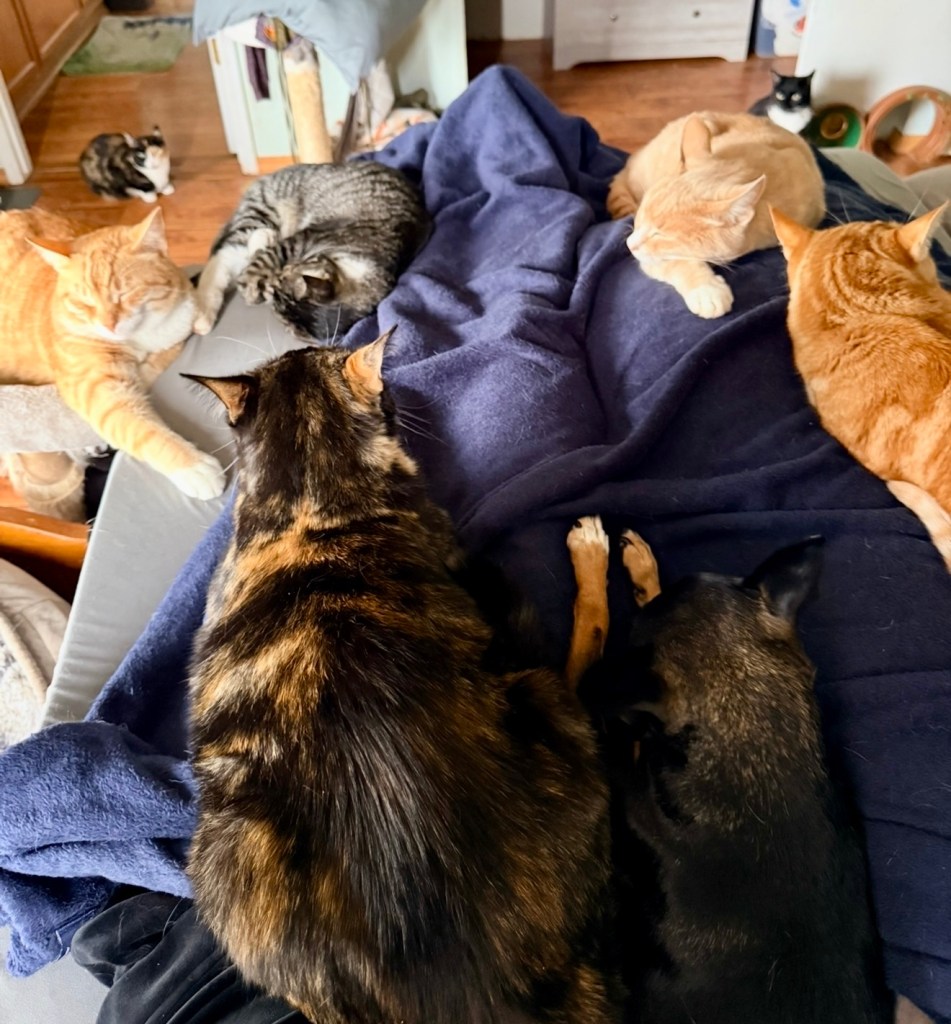
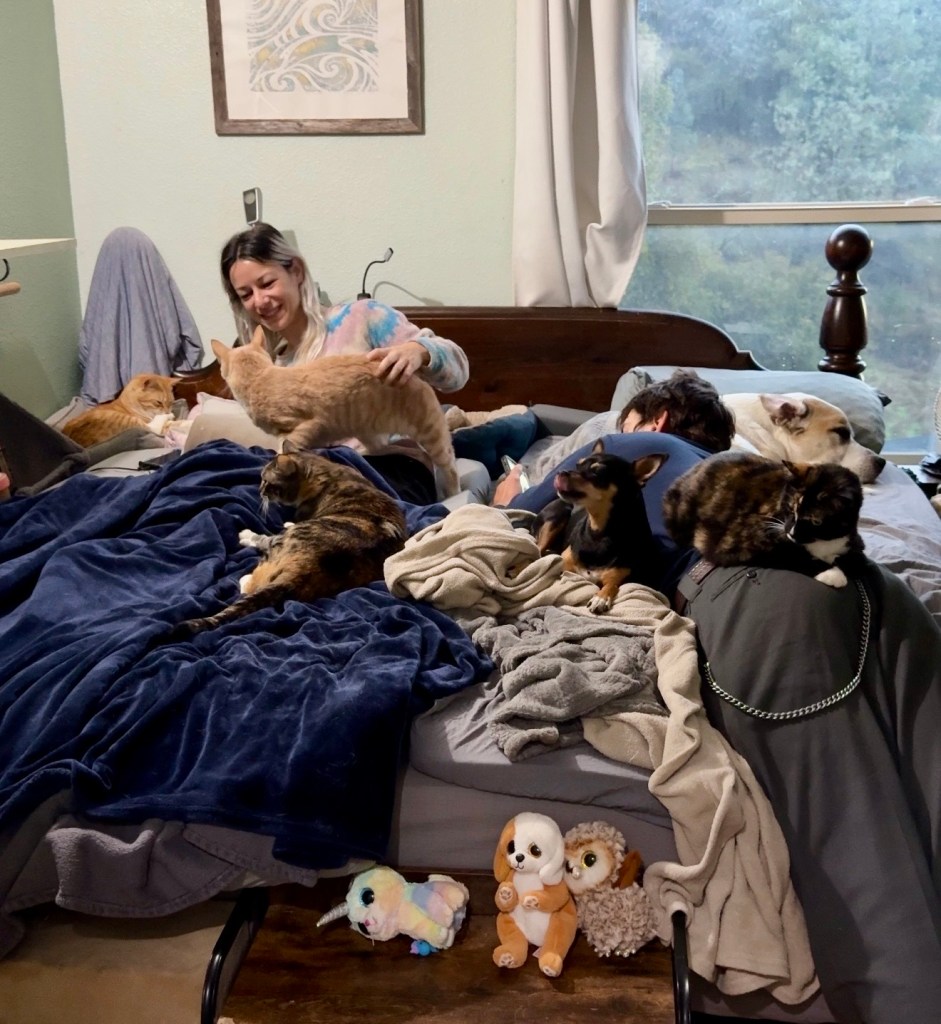
    A cozy scene with multiple cats and a small dog lounging together on a blanket in a living room.
    A woman sitting on a bed surrounded by several cats and a dog, with blankets and stuffed animals scattered around.

    The “Boring” Biohack:

    Most people think I reach for a pot of coffee the second my feet hit the floor. But actually, I’ve learned a little secret about our biology: you should wait 60 to 90 minutes before having caffeine.

    So, while I’m helping Cat Dad prep his food for work and getting my own day started, I’m strictly hydrating with lemon and salt water. It sounds simple, but if your brain is dehydrated, no amount of caffeine can fix the fog.

    6:00 AM: The Reset

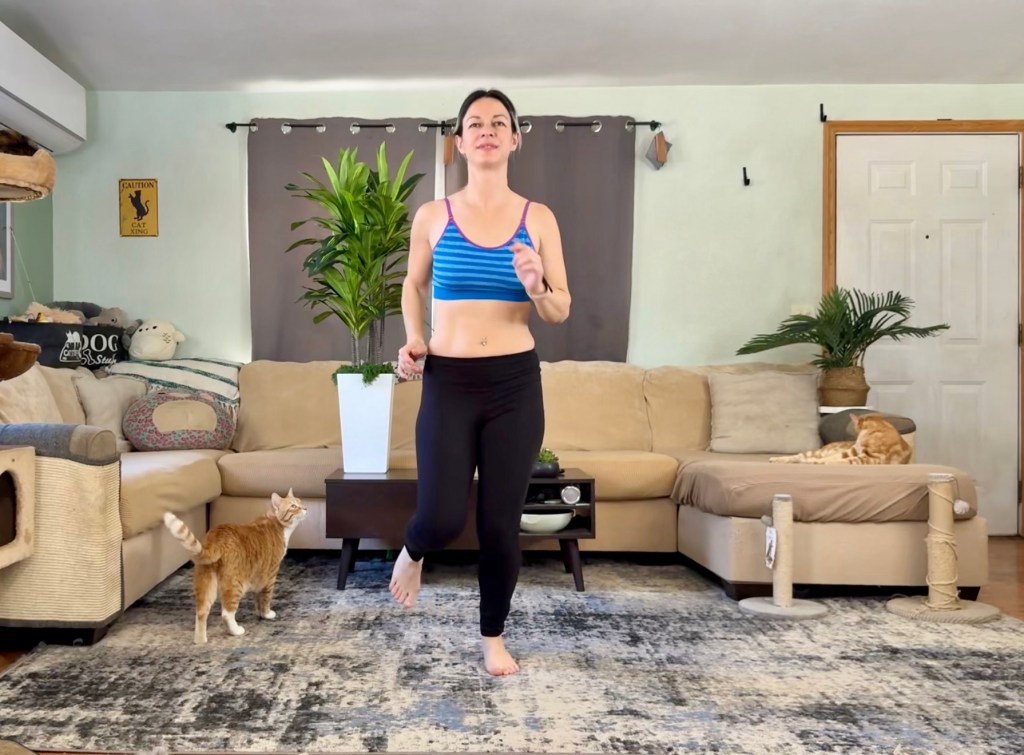
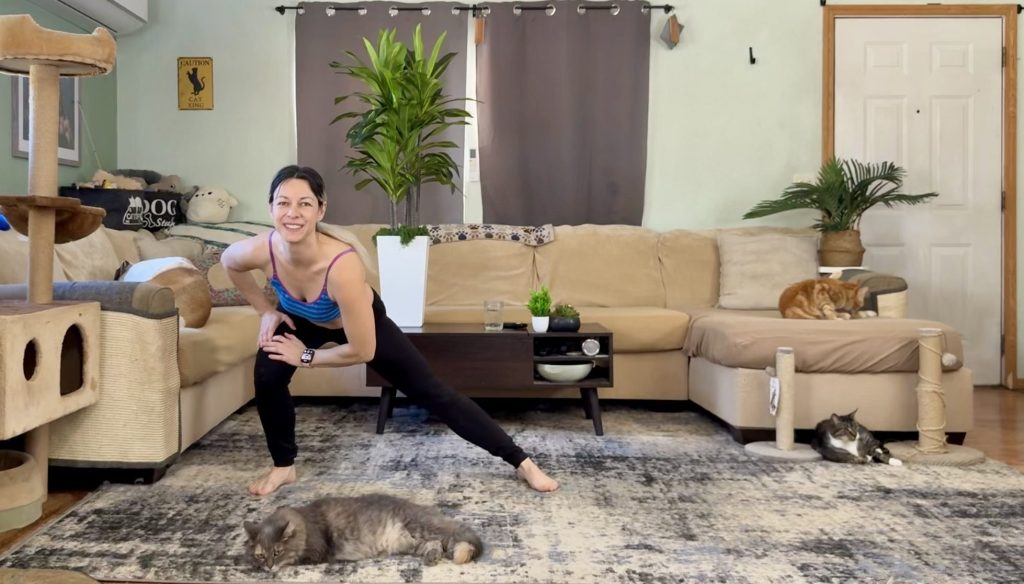
    Once Cat Dad heads out, it’s BODi time. Honestly, with 13 cats and a 10-acre property to manage, I don’t have time to drive to a gym. I need a half-hour workout I can do right here in my living room. This movement is my “biological reset.” It flushes out the morning fog and gets me ready for the main event: The Feeding Frenzy.
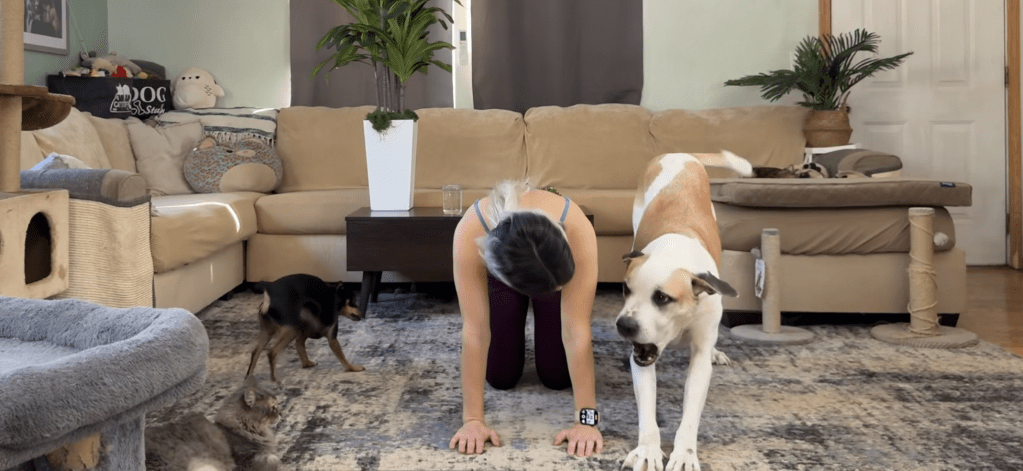
    A woman in workout attire is on her hands and knees on a rug in a living room, while a large dog stands nearby and a small dog and cat are also present in the scene. The room features a couch, plants, and pet furniture.

    6:30 AM: The Fuel (Timing is Everything)

    When you have 13 cats and 2 dogs, you can’t afford to be a “morning zombie.” Now that my 90-minute window is up and my workout is done, I’ve officially swapped my coffee for Club Early Bird.

    Not only does it have a clean caffeine blend, but it also has electrolytes and L-Theanine. It gives me that clean, “get-it-done” energy without the jitters so I can step into my role as a short-order cook for 15 hungry animals.

    7:00 AM: The Feeding Frenzy

    Feeding 13 cats is an art form. It’s not just ‘kibble in a bowl.’ I have the ‘weight management’ crew, the picky eaters who look at me as though I’ve offended them if I don’t give them the food they like group, and thankfully, the ‘I’ll eat anything’ group, I’m basically a short-order cook at 7 AM. I rely on Nulo cat food because it actually keeps the picky ones happy and the healthy ones on track. If you’ve got a multi-cat household, you know the struggle of the ‘separate bowl’ dance, and 13 of them is no joke!
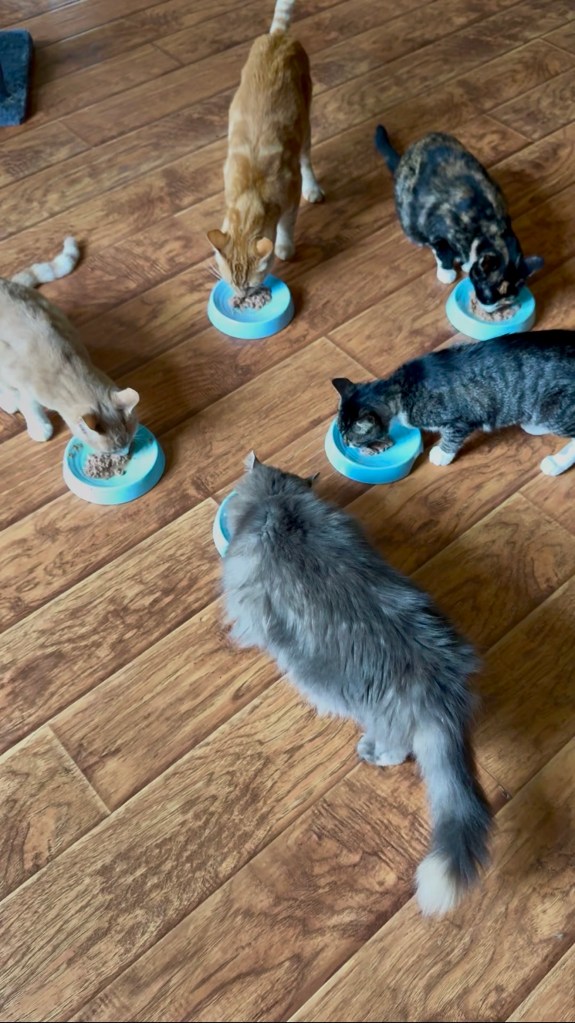
    Five cats eating from blue bowls on a wooden floor.

    7:30 AM: The Property Rounds 

    Once the cats are satisfied, the dogs get a turn. I take the dogs for their walk, followed by their breakfast (luckily they will eat anything!), and then I finally head out to make sure my garden is cared for.

    9:00 AM: Next up is the biggest block of my morning — training.

    Training all 15 animals takes an incredible amount of focus and patience. I give each pet a 10-minute one-on-one session for trick training and individual attention. So, yes, my ‘training’ block takes about 2.5 to 3 hours of my day!

    A woman with light hair and a purple sweater is playfully reaching out her hand to a calico cat. The background features a scenic waterfall surrounded by greenery.

    12:00 PM: Cleaning Session

    Once the animals are worked, I move into a house-cleaning session to maintain my mental clarity. Somewhere in the middle of the chores, I remember to finally feed myself and get the cats their lunch (because in this house, cat lunch is a non-negotiable requirement!).

    1:30 PM Clearing the “Mental Browser Tabs”

    After the morning whirlwind, it’s finally time for me to sit down and work. This is where my brain usually tries to bail on me because of the afternoon slump.

    Before I start writing or researching, I usually spend 10-30 minutes doing a guided meditation. After a morning of feeding, training, cleaning, and managing 15 animals, my brain feels like it has 47 tabs open at once.

    I’ve been using Mindvalley because it gives me structured meditations and mindset exercises that help me transition from “pet-mama mode” into focused work mode. It’s amazing how much easier it is to concentrate when I give my brain a few minutes to slow down first.

    5:00 PM: The Evening Shift

    Making dinner for us humans, eating, cleaning the kitchen (again!), feeding the cats and dogs their dinner, and eventual relaxation, The cycle starts to slow down, but my brain is usually still buzzing.

    8:00 PM: The Wind-Down

    It’s hard to “turn off” the mama-brain. Even after the animals are fed, the kitchen is cleaned, and the house is finally quiet, my brain still wants to keep solving problems.

    I’ve learned that if I want to be asleep by 9:00 PM, I have to start winding down long before my head hits the pillow. So I dim the lights, put away the screens, and give myself a little time to decompress before bed. It’s not exciting, but it’s one of the biggest reasons I’m actually rested enough to enjoy those 5 AM cat snuggles instead of resenting my alarm clock.

    The Nerd Side of Fatigue

    For the longest time, I was a zombie all day. I never could have imagined getting through a day as busy as this. I just thought I was “bad at being a morning person” or that the “3 PM slump” was just my price for having so many animals.

    But because I’m a total nerd at heart, I had to know why. I took a deep dive into the Neuroscience of Fatigue for my YouTube channel, The BioPsych Lab with Lainey. It turns out, there’s a biological reason for the “Zombie” feeling and the “Wired” feeling at night! Watch it here:

    Watch and Subscribe on YouTube! → Why Am I So Tired? 3 Biological Archetypes of Fatigue (& How to Fix Them)

    It was so cool to see the science actually confirm why my routine works. For example, my Early Bird isn’t just a drink, it’s helping me manage my caffeine timing so I’m not constantly fighting my body’s natural sleep-pressure signals. And that evening wind-down routine? It turns out there are real biological reasons why giving your brain time to transition into sleep mode can make such a big difference in how rested you feel the next day.

    If you want to geek out on the science with me, definitely check out that video. But if you just want to skip the lecture and start feeling like a human again, here is my ‘Pet Mama Survival Kit’ summed up:”

    The “Survival Kit” Summary

    • The Morning Jumpstart: Club Early Bird – No coffee jitters, just clean focus for the feeding frenzy (get 10% off with coupon code LAINEY10 !)

    • The Daily Movement: BODi – Huge variety of workouts from 5 to 60+ minutes so you can always find something that works with your schedule to flush the fog before the chaos begins (make sure to get 15% off with code ELAINEIBODI !)

    • The Feeding Secret: Nulo Cat Food– Because 13 cats shouldn’t mean 13 different types of cat food.
  • Why Am I So Tired? 3 Hidden Patterns Behind Your Fatigue (& How to Fix Them)

    Watch and Subscribe on YouTube! → Why Am I So Tired? 3 Biological Archetypes of Fatigue (& How to Fix Them)

    Transcript

    Ever feel like you’re doing everything you’ve  been told, but you’re still exhausted? Like, not just I stayed up too late tired, but a deep  soul level I need three naps tired. Yeah, I’ve been there through most of my life.

    So, using my  degree in biology and psychology, I’ve spent way too Ever feel like you’re doing everything you’ve been told, but you’re still exhausted? Like, not just “I stayed up too late” tired, but a deep, soul-level, “I need three naps” tired?

    Yeah, I’ve been there through most of my life. So, using my degree in Biology and Psychology, I’ve spent way too much time looking into why our brains seem to fail us when we need them the most. I’m here to share what I’ve learned in hopes that it will help you feel better, too.

    Hi, I’m Lainey, and welcome to The BioPsych Lab. I’m on a mission to decode the science of how we think, feel, and function so we can all understand our biology and learn how to feel better in life.

    Today, we’re tackling the one thing I get asked about more than anything else: Why am I so tired all the time?

    Now, there are a ton of possible reasons for fatigue. It could be your thyroid. It could be an iron deficiency. Or maybe you’re just not getting enough electrolytes. We could spend tens of hours talking about the medical side of things, but today I want to give you an overview of what I call the three biological archetypes of fatigue.

    These are the three most common ways our daily habits and brain chemistry clash, creating that heavy, sluggish feeling.

    In this video, I’m going to give you a summary of each type, explain the actual science behind why it’s happening, and then give you three evidence-based biohacks for each to help you start fixing it today.

    By the end of this video, you should be able to spot exactly which archetype—or archetypes—you fall into so you can stop guessing and start working with your biology.

    Let’s break them down.

    Archetype One: Morning Fatigue (The Zombie)

    You wake up, the alarm is screaming, and you feel heavy. Not just sleepy, but heavy.

    This was me every single morning until I learned about adenosine.

    Think of adenosine like a biological sleep-pressure gauge. From the moment you wake up, it starts building. By the time you go to bed, the gauge is full and you fall asleep.

    While you’re asleep, your body washes that adenosine away. But if you don’t get enough high-quality sleep, you wake up with residual adenosine. You feel like you have a hangover—but without the fun party the night before.

    In reaction to this, most people immediately reach for coffee as soon as they wake up so they can start functioning again.

    The problem is that caffeine works mostly by blocking adenosine receptors, which can temporarily mask that sleep pressure without actually removing it. Worse, chronic or repeated caffeine use can also produce tolerance. That same dose feels less effective, and the crash can feel worse when the stimulant wears off.

    This state tends to reduce drive, slow reaction time, and make starting tasks feel effortful because the brain is still carrying unmet sleep pressure.

    People often misread the problem as low willpower, but it’s usually a mix of homeostatic sleep debt—the cumulative difference between the amount of sleep your body needs and the amount it actually gets—and stimulant masking, where the caffeine you drink masks rather than treats the problem.

    So if you’re in this vicious cycle like I was, what can you do?

    Here are some science-backed ways to get your energy back.

    First, delay caffeine for 60 to 90 minutes after waking. Let your natural adenosine-clearing processes happen first so you don’t end up in that caffeine debt cycle.

    Believe me, I know this is easier said than done. But once you form this habit, you will feel so much better.

    Instead, use that first period after waking for an energizing morning routine, such as low-intensity movement like stretching, walking the dogs, doing a quick five-minute sun salutation, or even just stepping onto your porch to breathe in the morning air.

    This helps your system flush adenosine naturally.

    Number two: only drink caffeine strategically. Don’t do it continuously.

    Stop the top-offs and drinking coffee all day long. Research shows that continuous dosing builds tolerance and actually makes that eventual crash feel much worse.

    And lastly, prioritize sleep-pressure relief. This means aiming for a consistent bedtime and wake time, plus the gold-standard intervention: morning bright light.

    Get outside if you can, and if not, turn on all the bright lights you can in your house.

    Bright light has been shown to strengthen your circadian timing and tells your brain to stop producing melatonin and start clearing that sleep pressure.

    Archetype Two: The Midday Slump (The 3 P.M. Crasher)

    It’s 3 p.m. You’ve had your lunch, you’re staring at your computer, and suddenly you’d give anything for a pillow.

    Your focus is completely gone.

    This is also something I’ve struggled with for most of my life, and I still have my bad days.

    This archetype is so common because it’s a two-front war involving glucose regulation, decision fatigue, and your natural circadian dip.

    Front one is metabolic.

    Your blood sugar—glucose—might be crashing based on what you ate for lunch.

    This could be a simple fix. Choose your lunch mindfully. Include adequate protein and fiber to reduce post-meal glucose swings, and skip the heavy carbs.

    Something that interested me is that real-world data shows women are especially sensitive to these sugar-fatigue associations.

    Additionally, something you can do is take a 10-to-20-minute walk around lunchtime. Studies show that movement stabilizes glucose and blunts that afternoon slump.

    Front two is psychological: decision fatigue.

    By 3 p.m., you’ve made thousands of tiny choices, and your prefrontal cortex is literally running out of juice.

    This is partly explained by something called the Zeigarnik Effect. Our brains are hardwired to remember unfinished tasks better than finished ones.

    Those open loops are like a bunch of browser tabs running in the background of your brain, sucking up all your RAM.

    To fix this, you have to close those loops.

    Another thing I find easier said than done.

    Before 3 p.m., write a next-step list. But don’t just list the project. Define one tiny action you need to do next, followed by the next tiny action.

    That reduces rumination, which is the mechanism most closely linked to unfinished-task sleep impairment.

    Archetype Three: Nighttime Alertness (Tired But Wired)

    You’re exhausted all day, but at 11 p.m. your brain decides it’s time to solve world hunger—or remember a cringey thing you said back in 2014.

    In a healthy body, cortisol—the stress and alertness hormone—should be highest in the morning and lowest at night.

    But when you have chronic stress, it flips this curve.

    You’re low in the morning (zombie) and high at night (wired).

    This creates hyperarousal. Your body is tired, but your nervous system thinks it needs to be in fight-or-flight mode.

    And you can’t will yourself to sleep when your biology thinks you’re in danger.

    If this sounds familiar, here are three things you can do.

    Number one: use a strict wind-down routine with low light, no work email, and a consistent pre-sleep routine.

    We have to tell the nervous system it’s safe to disengage.

    Number two: do a five-to-ten-minute worry dump or planning session earlier in the evening so your mind has a chance to let it go before you hop into bed.

    Spend five to ten minutes writing down everything stressing you out or everything you need to do the next day.

    This removes unfinished-task rumination from your head and puts it onto paper.

    And number three: just like with all the other archetypes, be consistent with your sleep time, wake time, and morning light exposure.

    This is one of the most evidence-backed ways to stabilize that flipped cortisol rhythm and circadian rhythm over time.

    Final Thoughts

    If you struggle with fatigue, understanding your biology is the first step toward taking your life back.

    So, which archetype—or archetypes—are you?

    Once you’ve identified yours, I encourage you to try one or all of the evidence-based biohacks I’ve listed for your type and let me know what’s working for you in the comments.

    And if you found this video helpful, don’t forget to like and subscribe.

    I’m going to continue researching and using science to understand and hack our brains and bodies so we can all live better, more fulfilled lives.

    I’m Lainey, and I’ll see you next time in the lab.

    🏡 Want to see why I’m so tired? Check out 5 AM Alarms & 15 Rescues: My Survival Guide to Life as a Tired Pet Mama” A Day in My Life with 13 Cats and 2 Dogs

    MEDICAL DISCLAIMER: This video is intended for educational and wellness purposes only and should not be considered medical advice. Always consult a qualified healthcare professional regarding medical concerns, diagnoses, or treatment decisions.

    REFERENCES & FURTHER READING:

    1. Reichert CF, Deboer T, Cajochen C, et al. Adenosine, caffeine, and sleep-wake regulation: state of the art. J Sleep Res. 2022;31(4):e13597. doi:10.1111/jsr.13597.

    2. Liu PY, et al. Rhythms in cortisol mediate sleep and circadian impacts on health. Sleep. 2024;47(9):zsae151. doi:10.1093/sleep/zsae151.

    3. The role of sleep and the effects of sleep loss on cognitive performance. PMC-hosted review. 2025.

    4. The influence of food intake and blood glucose on workplace sleepiness and productivity. PMC-hosted review. 2025.

    5. The effect of different times of day for exercise on blood glucose regulation. PubMed-indexed study. 2024.

  • Home Workouts for Busy Pet Parents: Fitness, Fur, and Fun When Your Pets Run the House

    Home Workouts for Busy Pet Parents: Fitness, Fur, and Fun When Your Pets Run the House

    If you had asked me a few months ago how my fitness routine was going, I probably would have laughed, or just changed the subject.

    Life has a way of getting loud, doesn’t it? For me, that “loud” is very literal. I live with 15 pets. Most of my day is entirely dedicated to them including proper feeding, cleaning, training, and making sure everyone is healthy and happy. By the time I’ve finished making sure 15 other heartbeats are taken care of, I usually have zero energy left for my own.

    I fell into a major lapse. I wasn’t working out, and the gap between “who I used to be” and “where I was” felt like a canyon I couldn’t cross.

    The Myth of the “Perfect” Gym Workout

    When I first committed to getting back into a consistent fitness routine, my first thought was to look at local gym memberships. But let’s be real for a second, between the drive time, the packing of the gym bag, and the sheer logistics of leaving a property with 15 animals to manage, going to a traditional brick-and-mortar gym just wasn’t realistic.

    Every hour away from the house is an hour away from property chores, family time, and pet care. Plus, to be completely honest, leaving my fur babies behind to go stare at a blank gym wall or a boring television screen didn’t sound appealing at all.

    I didn’t want a fitness routine that forced me to escape my life; I wanted a routine that fit seamlessly into it. That’s when I realized the solution was right in front of me: home workouts.

    And the truth? A 20-minute workout in your living room while your dog tries to lick your face is 100% better than the 60-minute gym session you never actually went to. Whether you have 15 pets like me, or just one high-needs dog and a hectic job, we all share that same feeling of being at the bottom of our own to-do list. The “secret” to consistency isn’t finding more time; it’s finding a system that fits into the chaos you already have.

    Finding the Tool That Actually Stuck: The BODi Subscription

    I finally made the switch to at-home workouts, specifically using the BODi Subscription, and it changed my entire approach to wellness. Here’s why it’s the ultimate hack for the busy pet mama:

    1. The Zero-Commute Advantage

    If you only have 30 minutes to spare, you can’t spend 15 of them in the car. By working out at home, I can go from “Mama duty” to “Workout mode” in the time it takes to change my shoes. This saved time is more than just a convenience; it’s the difference between actually exercising and giving up because the logistics were too hard.

    2. Everything is Included

    You aren’t constantly being asked to buy the “next” thing. Once you have the membership, every single program they’ve ever made is right there in the app.

    It also includes nutrition plans and mindset masterclasses, which I actually found helpful for managing the “busy mama” burnout.

    3. Your Pets Actually Help (Usually)

    While it might seem like pets are a distraction, they can actually keep you accountable. My crew knows when the workout mat comes out, it’s a specific time of day. It builds a routine for them, too.

    Plus the best part: you never have to feel guilty about leaving them behind to go to a gym! They get to be part of your healthy lifestyle.

    How I Finally Broke the Lapse

    Once I had access to the entire BODi library, I had to figure out where to actually start. I knew if I tried some crazy, high-intensity bootcamp, I’d quit after three days.

    I scrolled through the options and found 4 Weeks 4 Every Body. I chose it specifically because it’s a low-impact program. I didn’t want to start with a HIIT program or jump around and feel defeated; I just wanted to move again. The cast was actually fun to watch! They didn’t feel like “fitness robots.” And for the first time in a long time, I felt good after a workout instead of exhausted.

    That program was the bridge. It made me feel so good in my own body that it gave me the strength and the motivation to eventually move up to higher-impact workouts. It proved that I didn’t have to start at 100%—I just had to start.

    The Best Part of Working Out at Home? The Four-Legged Moral Support

    A lot of fitness blogs will tell you how to “isolate” yourself from your animals or how to work out without interruptions. But around here, we don’t do that. Involving my pets in my daily movement has made working out one of the absolute best, most joyful parts of my day.

    If you’ve never tried to do a workout with a large pet family, you are missing out. Here is what my “fur-assisted” fitness routine actually looks like:

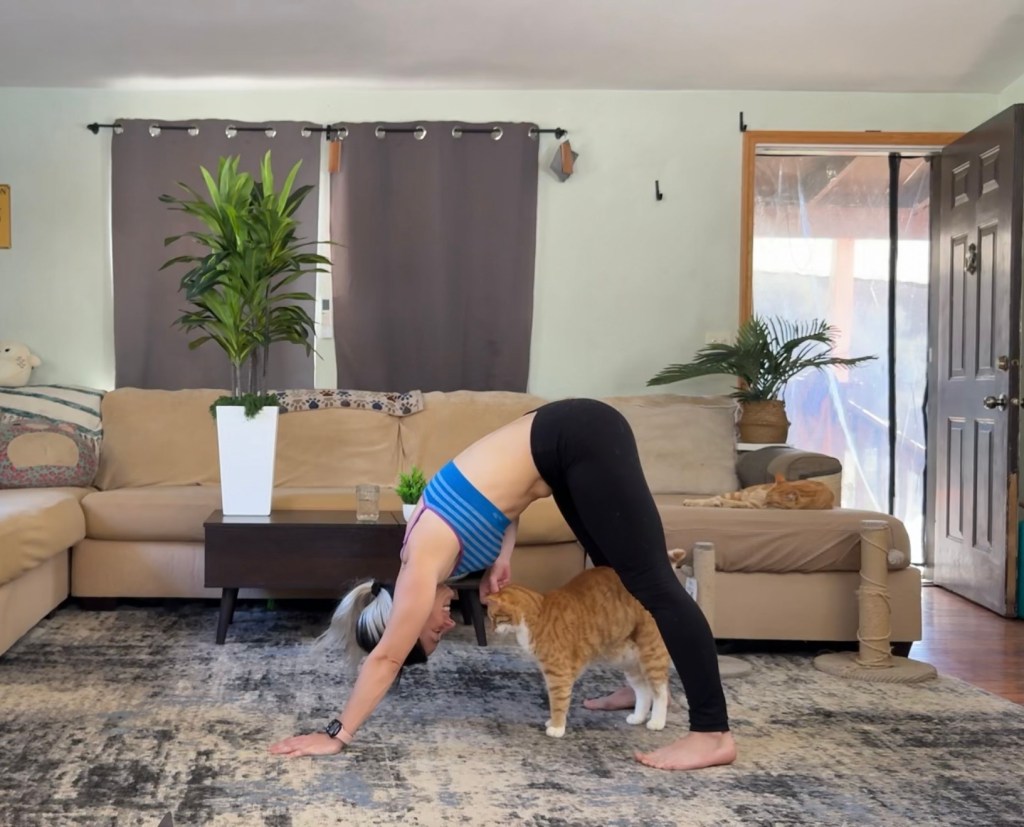
     Built-in Resistance Training: Who needs fancy gym weights when you have cats? Trying to hold a plank or push-up position becomes a hilarious core workout when a cat decides your back is the perfect place to take a afternoon nap.

     The Ultimate Yoga Mat Magnets: It is a universal scientific law that a yoga mat cannot touch the floor without a cat immediately claiming it as their new bed or scratcher. Instead of fighting it, I’ve just learned to share the mat space.

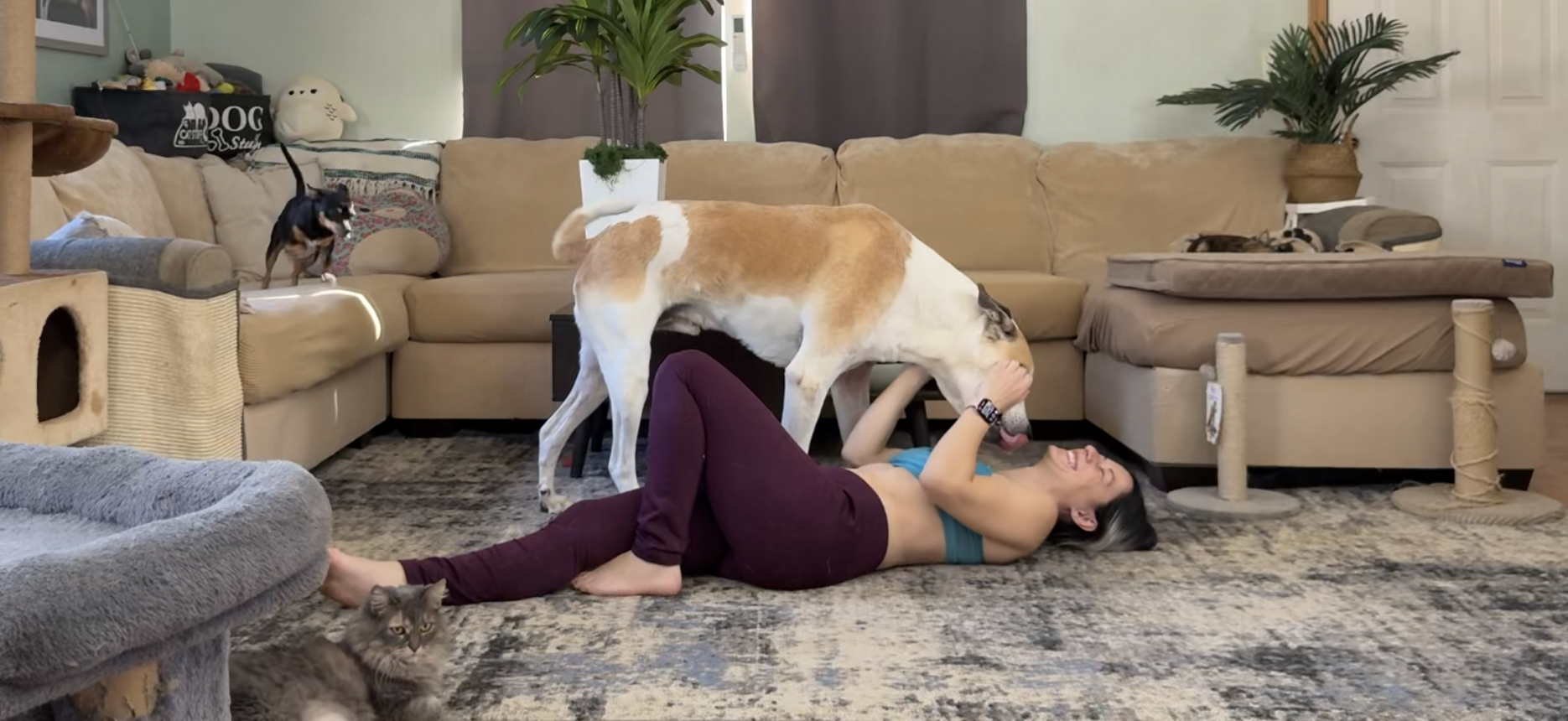
     Over-Enthusiastic Cheerleaders: My dogs genuinely think that whenever I get down on the floor for stretching or floor work, it’s a low-profile invitation for face licks and cuddles.

    The only thing you truly have to be careful of is situational awareness! Depending on the dynamic moves you’re doing, you definitely have to watch your step so you don’t accidentally trip over an over-enthusiastic fur baby who wants to participate. But otherwise? Having them involved makes the entire process incredibly fun!!

    A woman performing a yoga pose with her hands on the floor and her back arched, while an orange cat rubs against her leg in a cozy living room setting.

    Let’s Be Healthy Pet Parents Together!

    If you’ve been in a lapse, or if you feel like your pets have taken over your entire identity, I get it. You don’t need a gym. You don’t even need a lot of time. You just need to start somewhere that feels doable.

    For me, that was getting a BODi membership and starting with 4 Weeks 4 Every Body. It’s the only thing that’s actually fit into my “15-pet” life without making me feel more stressed. If I can do it, you can too! Click here to check out the subscription plans, nutrition plans, supplements, and more, and use code ELAINEIBODI for 15% off!

    (The links above are affiliate links, meaning I may earn a small commission at no additional cost to you. I only share products I genuinely use and believe in!!)